
News
21/02/2024
Anti-Amyloid Beta Antibodies in Late-Phase Clinical Trials: Unveiling Binding Dynamics
- Amyloid beta-binding properties of aducanumab, lecanemab, and gantenerumab investigated
- All antibodies favor high molecular weight amyloid beta variants over monomers
- Specific binding characteristics differ vastly between all antibodies
A recent study by Söderberg et al. (2023) employed three different approaches, i.e. inhibition ELISA, immunodepletion, and surface plasmon resonance (SPR) to characterize the binding of the three antibodies to various amyloid beta (Aβ) species, including monomers, oligomers, protofibrils, and fibrils. Interestingly, all antibodies demonstrated a low affinity for Aβ monomers. Specifically, lecanemab and aducanumab showed very weak binding to monomers, with gantenerumab exhibiting a slightly stronger affinity.
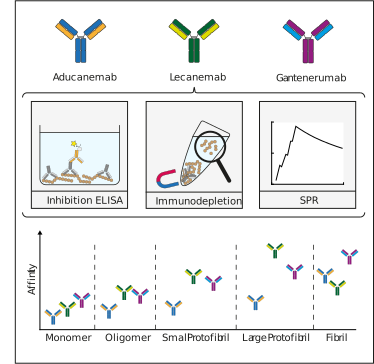
The study found major differences particularly in the binding of oligomers and protofibrils. Lecanemab stood out with its strong affinity to protofibrils, which grew further with increasing protofibril size. Gantenerumab displayed similar, but not as strong results; aducanumab demonstrated the lowest binding affinity in all cases. It is noteworthy that lecanemab demonstrated a tenfold stronger binding to soluble protofibrils than to fibrils. In contrast, aducanumab and gantenerumab showed a binding preference towards fibrils.
This study provided deeper insights into the binding behaviors of the three tested antibodies towards different Aβ species. Both, aducanumab and lecanemab received accelerated approval from the United Stated Food and Drug Administration (FDA) for treatment of early stage AD (mild cognitive impairment/mild dementia state) in 2021 and 2023, respectively. While the FDA has given full approval for lecanemab in July 2023, the marketing of the previously approved aducanumab was discontinued. Gantenerumab on the other side has not yet been approved, mostly due to disappointing results in Phase III trials in 2022 [1].
Whether the binding affinity of anti-Aβ Antibodies has any effects on the efficiency of Aβ-clearance from patients’ brains, and whether this influences the clinical efficacy of these antibodies, remains to be investigated.
This article refers to:
Söderberg L, Johannesson M, Nygren P, Laudon H, Eriksson F, Osswald G, Möller C, Lannfelt L (2023) Lecanemab, aducanumab, and gantenerumab – binding profiles to different forms of amyloid-beta might explain efficacy and side effects in clinical trials for Alzheimer’s disease. Neurotherapeutics 20:195–206. DOI: 10.1007/s13311-022-01308-6
Further References:
[1] Bateman RJ, Smith J, Donohue MC, Delmar P, Abbas R, Salloway S, Wojtowicz J, Blennow K, Bittner T, Black SE, Klein G, Boada M, Grimmer T, Tamaoka A, Perry RJ, Turner RS, Watson D, Woodward M, Thanasopoulou A, Lane C, Baudler M, Fox NC, Cummings JL, Fontoura P, Doody RS (2023) Two phase 3 trials of gantenerumab in early Alzheimer’s disease. N Engl J Med 389:1862–1876. DOI: 10.1056/NEJMoa2304430