
News
05/08/2026
Challenging the Central Dogma of Molecular Biology
For more than five decades, the central dogma of molecular biology, proposed by Francis Crick (co-discoverer of the DNA double-helix structure), has served as a cornerstone of modern biology: sequence information can flow between DNA and RNA and from nucleic acids to proteins, but once it reaches a protein, it cannot flow back.¹˒²
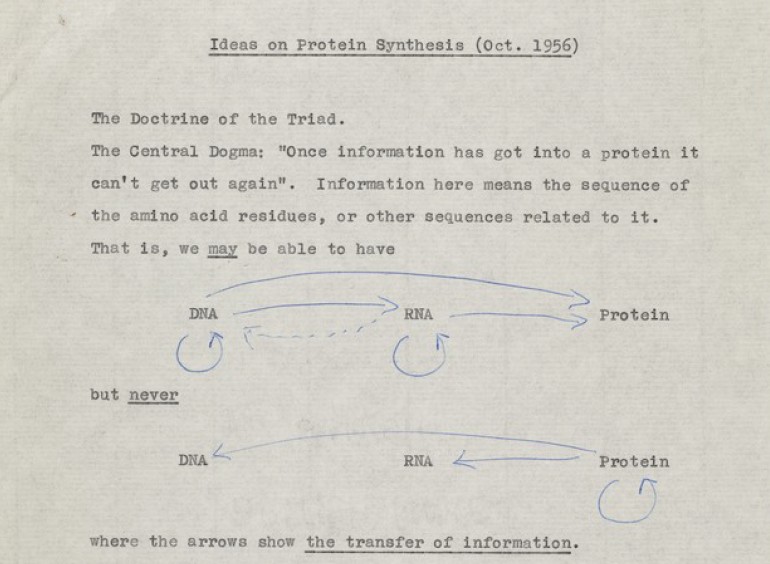
Figure 1. Francis Crick’s first outline of the central dogma, from his unpublished notes Ideas on protein synthesis (1956). Source: Wellcome Collection, Francis Crick Archive (CC BY-NC).
Deng et al. now report the first example of protein-templated DNA synthesis, demonstrating that simple, repetitive DNA sequences can be synthesized directly from a protein template³. In the bacterial antiphage defense system DRT3 (defense associated reverse transcriptase 3), two reverse transcriptase subunits cooperate to synthesize an alternating poly(GT/AC) double-stranded DNA that protects bacteria against phage infection. While the Drt3a subunit generates one DNA strand using a conventional non-coding RNA template, the Drt3b subunit follows a fundamentally different strategy: conserved amino acid residues within its active site directly recognize adenine and cytosine nucleotides, thereby guiding the synthesis of a complementary poly(AC) strand. Using cryo-electron microscopy and functional assays, Deng et al. identified residues such as Glu26 and Arg253 as key determinants of nucleotide selection, revealing how a network of protein–nucleotide interactions can effectively act as a template for DNA synthesis³. Collectively, these findings challenge the long-held assumption that sequence information cannot be transferred from protein to DNA.
Although this mechanism has so far been observed only in a specialized bacterial antiphage defense system and is currently restricted to the synthesis of a simple repetitive DNA sequence, the discovery raises a much broader question. Is DRT3 a unique evolutionary curiosity, or has nature revealed the first example of a previously overlooked class of protein-templated nucleic acid polymerases? At present, this question remains unanswered. However, history has repeatedly shown that seemingly isolated biological phenomena can uncover entirely new molecular principles. If analogous mechanisms are discovered in other organisms or biological contexts, this work could ultimately necessitate a fundamental revision of Crick’s central dogma, reshaping our understanding of information flow in molecular biology.
Beyond its conceptual significance, the discovery also opens exciting opportunities for the development of novel biotechnological and synthetic biology applications.
References
[1] Crick F (1970) Central dogma of molecular biology. Nature 227:561–563. DOI: 10.1038/227561a0.
[2] Cobb M (2017) 60 years ago, Francis Crick changed the logic of biology. PLoS Biol 15:e2003243. DOI: 10.1371/journal.pbio.2003243.
[3] Deng P, Lee H, Armijo C, Wang H, Gao A (2026) Protein-templated synthesis of dinucleotide repeat DNA by an antiphage reverse transcriptase. Science 392:1274–1281. DOI: 10.1126/science.aed1656.